


Egypt’s food exports reached a record first-half value of $3.771 billion in 2026, compared with $3.414 billion in the same period of 2025, recording 10.5% growth and an increase of $357 million, in a performance that signals more than a numerical rise in export value.
The importance of this record lies in the structure behind the growth, as the increase was not driven by one destination or a single product category, but by a broader mix of markets and food products, making the first-half performance a stronger indicator of export maturity.
The clearest signal is that 108 markets increased their imports of Egyptian food products during the first half of 2026, with total positive market gains reaching $547 million, while the net increase in sector exports stood at $357 million.

This gap between positive market gains and net export growth shows that expanding destinations helped offset declines in other markets, reflecting a more dynamic and diversified export map for Egypt’s food industry.
The quarterly performance adds another important layer to the analysis, as exports reached $1.764 billion in the first quarter of 2026, growing 7.5%, before rising to $2.007 billion in the second quarter, growing 13.2%.
The second quarter accounted for around 53% of total first-half exports and contributed nearly 66% of the total increase achieved during the six-month period, confirming a clear acceleration in export momentum after March.
This acceleration gives the second half of 2026 a different starting point, as Egypt’s food exports entered mid-year with stronger demand signals, wider market activity and a more visible shift toward value-added products.
Arab countries remained the largest destination group for Egyptian food industry exports, reaching $1.737 billion and accounting for around 46% of total sector exports, confirming the continued importance of regional markets for Egyptian suppliers.
The European Union, however, recorded the strongest growth rate among the main international groups, with exports rising to $852 million, up 15.4%, and increasing its share to around 23% of total sector exports.
The EU performance is particularly important because growth in these markets usually reflects progress in areas such as quality compliance, traceability, technical standards, packaging and supply consistency.
At the same time, exports to non-Arab African markets remained almost flat at $252 million, with growth of only 0.4%, showing that one of Egypt’s closest regional opportunities has not yet become a major growth engine for the sector.
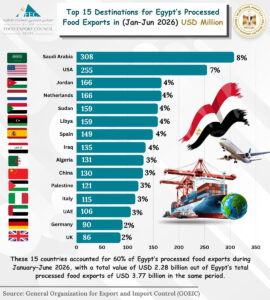
At the market level, Saudi Arabia maintained its position as the largest importer of Egyptian food industry products, with exports reaching $308 million, followed by the United States at $255 million, while Jordan and the Netherlands each recorded $166 million.
Spain delivered one of the strongest market performances, with exports rising to $149 million and recording 94% growth, supported by higher shipments of edible oils, processed olives and prepared animal feed.
Spain’s growth reflects a broader shift in European demand for Egyptian value-added food products, especially in categories where processing, packaging and consistent supply can create stronger commercial positioning.
On the product side, frozen strawberries remained Egypt’s leading food industry export at $489 million, followed by soft drink concentrates at $306 million and edible oils at $230 million.
Chocolate became the most important product growth story in the first half of 2026, with exports jumping to $229 million, up 125%, and adding $127 million compared with the same period of 2025.
This surge in chocolate exports points to a notable shift in Egypt’s food export structure, as processed and higher-value food products are becoming more visible within the country’s export growth story.
Other growth drivers included edible oils, which added $48 million, fats and greases, which grew 60%, salt, which grew 95%, and chewing gum, which grew 195%, showing that export expansion is spread across both large-volume categories and fast-rising niche products.
Despite the record performance, the market map also includes warning signs, as several important destinations among the top 20 recorded declines, including Sudan, Libya, the United Arab Emirates, Germany, Lebanon, Morocco and Brazil.
These declines show that the record first-half value does not remove the need to monitor pricing, competition, distribution channels and demand shifts across key markets.
The top 20 importing markets accounted for around 70% of total Egyptian food industry exports, with a combined value of $2.633 billion, highlighting strong depth in core markets but also the continued importance of widening the export base.
Overall, the first-half export performance suggests that Egypt’s food industry is moving from traditional export growth toward a more diversified and mature export phase.
The record value of $3.771 billion is therefore not the end point, but the beginning of a new test in the second half of 2026, focused on sustaining momentum, deepening access to fast-growing markets, and turning product-level jumps into stable long-term trade flows.