

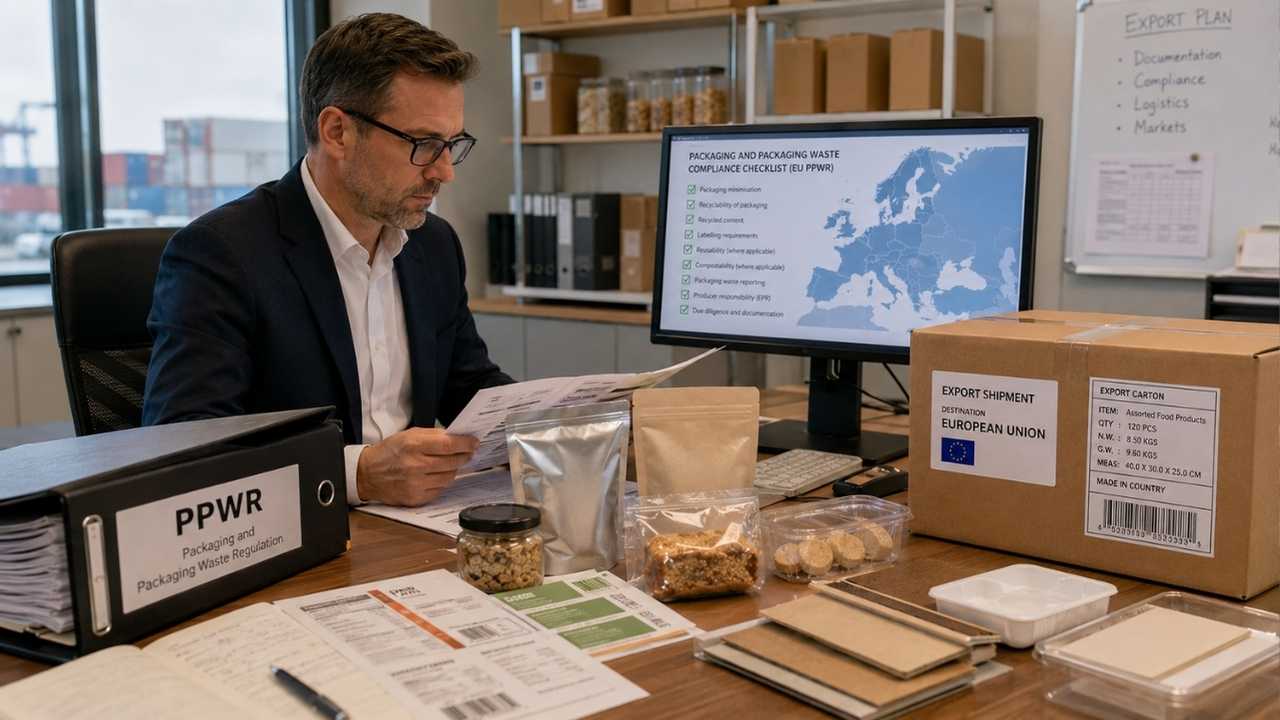
Food exporters supplying the European Union enter a new regulatory phase as the Packaging and Packaging Waste Regulation, known as PPWR, generally applies from 12 August 2026, making packaging compliance a direct export, documentation and buyer-confidence issue.
The European Commission states that PPWR covers all packaging and packaging waste regardless of material or origin, and sets requirements for manufacturing, composition and the reusable or recoverable nature of all packaging placed on the EU market.
PPWR Is a Market Access Issue, Not Only a Packaging Issue
Food exporters should not treat PPWR as a technical issue owned only by the packaging supplier.

The export manager will be the person receiving buyer questions about packaging materials, recyclability, labelling, supplier evidence, product documentation and the responsibilities of the importer or producer placing the packaged food on the EU market.
First File: Open EU Shipments
The first file on the export manager’s desk should list all EU-bound shipments scheduled for August and September 2026.
This list should include customer name, EU destination country, product, primary packaging, secondary packaging, shipping date, expected arrival date and whether the product is already produced, packed or still adjustable.
Second File: Packaging Inventory
Export teams should prepare an immediate inventory of every packaging component used for EU shipments.
This should include food-contact packaging, labels, cartons, shrink film, pallets, separators, transport packaging and any other packaging material entering the EU market with the product.
Third File: Supplier Declarations
Packaging suppliers should be asked today to provide material composition data, recyclability information, certificates, test reports and any available compliance declarations.
This does not complete the full PPWR compliance journey, but it gives exporters a documented starting point for buyer conversations and internal risk assessment.
Fourth File: EU Importer Confirmation
Export managers should contact each EU importer with open shipments and request confirmation of any country-specific registration, EPR, reporting or packaging documentation requirements.
PPWR is an EU regulation, but the practical handling of producer responsibility, competent authorities and national registers may still require coordination with the importer or in-market representative.
Fifth File: Artwork and Label Review
All EU packaging artwork should be reviewed for material information, symbols, recycling claims, sustainability claims, compostability claims and any environmental language.
PPWR introduces harmonised labelling requirements, with packaging labelling obligations linked to 12 August 2028 or 24 months after the relevant implementing acts, whichever is later, so the immediate task is not to redesign every label overnight but to prevent unsupported claims and create a structured update plan.
Sixth File: Environmental Claims
Claims such as recyclable, sustainable, eco-friendly, biodegradable or compostable should be checked against evidence.
A food exporter should not add new environmental claims to EU packaging without technical and legal validation, and any existing claim should be supported by supplier documentation or test evidence.
Seventh File: Food-Contact Packaging
Food-contact packaging should be treated as a priority category.
The European Commission highlights that PPWR includes requirements to minimise substances of concern, including restrictions on PFAS in food-contact packaging if certain thresholds are exceeded.
Eighth File: Technical Compliance Folder
Each EU customer or destination market should have a PPWR packaging compliance folder.
This folder should include packaging specifications, supplier data, certificates, artwork, photos, importer correspondence, material composition, internal review notes and any available declarations.
Ninth File: High-Risk Products
Exporters should classify products into high, medium and lower packaging-risk groups.
High-risk products may include those using complex plastic structures, composite materials, environmental claims, private label artwork or food-contact packaging that requires additional documentation.
Tenth File: Internal Action Meeting
The export manager should hold a short meeting with quality, procurement, packaging, marketing and customer service.
The meeting should assign responsibility for supplier follow-up, label review, importer communication, shipment list updates and documentation control.
What Not to Do in the Final 24 Hours
Exporters should not change packaging randomly without buyer confirmation.
They should not promise full compliance without evidence, ignore open shipments or confuse the general application date of 12 August 2026 with future implementation dates for specific requirements.
What to Send the EU Buyer Today
A short buyer message should confirm that the exporter is reviewing packaging used for EU shipments in light of PPWR’s general application date.
The message should also state that the company is collecting material data, packaging supplier information and label details, while asking the buyer to confirm any national registration, reporting or documentation requirements.
Practical Desk Checklist
List of EU shipments in the next 30 days.
Packaging component table for every EU product.
Supplier material declarations.
Latest EU packaging artwork.
Importer contact list.
High-risk packaging list.
Food-contact packaging review notes.
Environmental claims review.
PPWR technical folder.
Internal action owners.
Editorial Conclusion
The final 24 hours before PPWR are not the time to rebuild a full packaging compliance system from scratch.
They are the time to organize evidence, identify risks, contact suppliers and importers, and ensure that the export team can respond professionally when European buyers ask packaging-related questions.
FAQ
What is PPWR?
PPWR is the EU Packaging and Packaging Waste Regulation covering packaging and packaging waste placed on the EU market.
When does PPWR generally apply?
The regulation entered into force on 11 February 2025 and generally applies from 12 August 2026.
Do exporters need to change every package immediately?
Not necessarily, because some specific requirements have later dates, but exporters should review packaging evidence, labels, open shipments and buyer requirements now.
What should food exporters review first?
They should first review open EU shipments, packaging components, supplier documentation, EU buyer requirements and packaging claims.
Does PPWR affect non-EU exporters?
Yes, because it covers packaging placed on the EU market regardless of material or origin.