


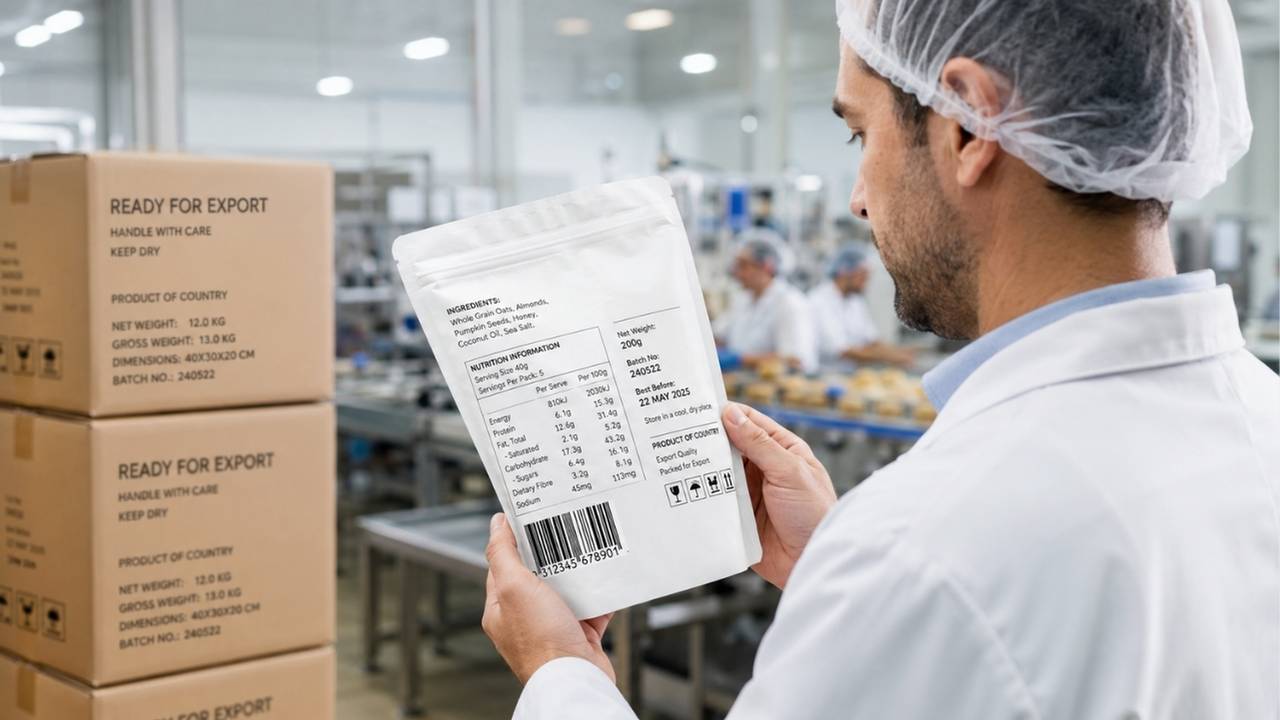
The decision to purchase a food product is no longer based solely on taste, price and attractive packaging, as consumers, importers and regulatory authorities now examine ingredient lists, country of origin, nutritional values, sustainability claims and warning statements before trusting a product or allowing it to enter the market.
Packaging Is No Longer Just Advertising Space
For many years, companies treated packaging primarily as a space for displaying the brand, an appealing image and a marketing message, but packaging has now become a commercial, regulatory and legal document that summarises the product’s entire journey, from the sourcing of raw materials to the factory and the market in which it will be sold.
The problem is that some companies still postpone label reviews until the final stage, after production has been completed and printing contracts have been signed, only to discover that the target market requires different ingredient wording, an additional allergen warning, a new order for mandatory information or evidence supporting one of the claims printed on the packaging.
Language Consumers Can Understand Without Being Misled
The growing global debate over simplifying ingredient names highlights a difficult equation facing food companies, as consumers want short and understandable ingredient lists, while regulatory authorities require precise information that prevents confusion or conceals the true nature of the substances used.
The objective is not to replace scientific terminology with attractive marketing phrases, but to present information clearly in a way that preserves scientific accuracy and helps consumers understand the function of each ingredient without feeling that the company is deliberately confusing them or hiding information.
Consumers who do not understand what they are reading may reject a product even when its ingredients are safe, but consumers who discover that a company has used simplified language to conceal an ingredient or exaggerate a health benefit may lose trust in the entire brand.
Exporting Begins Before Packaging Is Designed
A company planning to enter a new market must study food labelling regulations alongside market size, competitors and prices, because changing packaging after commercial quantities have been produced can consume a significant part of the profit margin, delay shipments and potentially lead to the cancellation of the deal.
Companies should not rely on literal translations of Arabic labels into English or French, as every market has its own rules governing ingredient names, nutritional values, allergen declarations, health claims, font sizes, the positioning of the country of origin and the way expiry or best-before dates must be displayed.
Marketing Claims Require Evidence
Terms such as “natural”, “healthy”, “high in protein”, “sugar-free”, “responsibly sourced” and “environmentally friendly” are no longer simply promotional expressions that can be placed freely on packaging, as they can become legal commitments requiring laboratory analyses, documentation, traceability systems and supporting evidence that can be presented during regulatory reviews or in response to objections.
Before placing any claim on a package, the company must ask whether it has sufficient evidence to support it, which organisation issued that evidence, whether it is recognised in the target market and whether it applies to the product itself or merely refers to the company or one of its suppliers in general.
Traceability Protects the Brand During a Crisis
Food safety crises do not only test product quality, but also test the company’s ability to identify the production batch, the source of the raw material, the manufacturing date, the customers who received the shipment and the time required to contact them.
A company with an accurate traceability system can limit the problem to specific batches and withdraw them quickly, while a company that lacks reliable data may be forced to recall a much wider range of products and bear financial losses and reputational damage that could have been avoided.
A Genuine Opportunity for Egyptian Companies
Egypt’s food industry benefits from a diverse product portfolio, expanding production capacity and extensive experience in exporting to different markets, but converting these advantages into sustainable growth requires greater investment in regulatory affairs, traceability, label design and data management.
Egyptian exporters who view market requirements as an additional burden will remain focused on competing through price, while exporters who transform compliance into a marketing advantage can build long-term trust and secure greater opportunities with importers, retail chains and private-label buyers.
The next phase of competition will not simply be between a cheaper product and a higher-quality one, but between a company that can prove every statement printed on its packaging and another that expects the market to accept its claims without evidence.
What Food Manufacturers Need to Do
Every food company that exports or plans to export should appoint a clearly identified person responsible for regulatory affairs, ensure that labels are reviewed before printing, continuously update market regulation databases and establish close coordination between quality, export, marketing and procurement departments rather than allowing each department to operate separately.
Companies also need to prepare a technical file for every product, including its formulation, laboratory analyses, raw-material sources, supplier certificates, permitted claims and approved label versions for each market, ensuring that the company does not have to start from the beginning with every new export deal.
Packaging that reaches the shelves of international retailers carries more than the product itself, as it also carries the manufacturer’s name, the reputation of Egyptian industry and the company’s ability to respect consumers and market regulations.
Food labelling has therefore become one of the most important tools for competition and export growth, rather than merely a final step completed before shipment.